Showing posts with label Exercise. Show all posts

Sunday, July 23, 2017

Bigger Leaner Stronger 2.1

Michael Matthews is a prolific writer, and in July last year he updated his book Bigger Leaner Stronger to version 2.1, introducing the concept of a "Strength Week" every 4 weeks. For those of you who don't know, I have made a series of spreadsheets that follow the Bigger Leaner Stronger Year One Challenge program. These can be found at http://www.fact-reviews.com/bls.
I have now finally updated my website with the new spreadsheets. They cover all 6 phases (each phase is 8 weeks, followed by 1 week rest) for each of the 5-day, 4-day and 3-day per week programs.
The idea is that you create a shared dropbox folder on your PC and your phone. Then you store the current phase spreadsheet in this folder, so you can update it on your phone while you are at they gym, between sets. On my Android phone I use WPS Office, a free program that is compatible with Microsoft Office. It uses the .xls format, not the newer (and larger) .xlsx format, so this reduces the file size, and the data usage when you update it on Dropbox. I'm sure there are IOS apps that can edit these files too.
Then when you get home from the gym you can print out the page of today's exercises, and keep a record of your progress. There is also space at the bottom of each page where you can keep track of your progress over the 8 week period. I find that this helps me monitor my improvements over time, which encourages me to improve, even by a small amount each week.
I started the Year One Challenge two years ago, and am now on phase 5 week 3. This is partly because I started over after recovering from a repetitive strain injury, and also because I go to gym 3 days a week but do the 4-day program, to ensure that each Tuesday I am on a different day with my personal trainer. He helps me make sure my form is correct, so I don't waste my time or do anything stupid that might cause an injury.

Friday, December 09, 2016

My Before and After Pictures So Far

A quick glance at these "before" and "after" images shows no dramatic change to my body shape after 2 years of training using the Bigger Leaner Stronger program. Or so you would think. Certainly my body measurements haven't changed much, but that's not the only data that matters. At least for me. I am 5kg heavier, yet not fatter. I am stronger in all the main 4 exercises that matter.
I don't have a record of my efforts for 2014, but I was struggling to do a Squat properly, and hadn't even attempted the Seated Military Press until 2015. I started keeping records of my exercises at gym in January 2015. So my stats (for at least one set of 6 reps) are:
Jan 2015
Deadlift 40kg
Squat 40kg
Seated Military Press 25kg
Bench Press 40kg
Dec 2016
Deadlift 100kg (+60kg)
Squat 90kg (+50kg)
Seated Military Press 40kg (+15kg)
Bench Press 60kg (+20kg)
Next week is "Strength Week", so these numbers may improve further. Either way, I am achieving personal best results in many of the exercises every week. Progress has been slow but steady, especially considering I turned 55 this year, and only have the time and energy to go to gym 3 times a week.
I have been going to the gym regularly for over 3 years now, and my progress has been great, at least for me. In August 2013 I couldn't do any of the basic exercises. I could manage around 5 pushups if I was lucky. Now I do 12 pushups as part of a warm-up routine. For me that's great progress, and it has been worth the time and effort. This week I am starting my warmup exercises with the weights I was doing as working sets in January 2015, or heavier. And the warmup sets start with 12 reps, not 6.

Sunday, September 13, 2015

Celebrating Two Years at the Gym


Its weird to think that I am "celebrating" two years of hard slog at the gym. For most of my life I have thought of myself as a "weakling", a "nerd", or and "intellectual", but never as a pserson of "normal" strength, let alone a "sportsman". But two years ago that changed. I decided to get serious about getting strong and fit. I just wanted to feel normal for once.
It's difficult to describe just exactly how different that feels. When I was in junior school I could count all the ribs on my chest. I had no muscle tone to speak of. Boys who punched me on the upper arm learned not to do that, because they encountered bone not muscle, and it hurt them as much as it hurt me. Sport was never intuitive or easy for me. I sucked at it, and focused on intellectual activities at school.
So now when I fold my arms across my chest to do decline abdominal crunches, I rejoice in feeling my chest muscles, and not just ribs or body fat. My legs and arms are no longer flabby, and my overall body fat percentage is moving downwards, but very slowly. Its still around 20%, which is high.
My best flat barbell bench press was less around 45% of my body weight. Now its closer to 80% of my body weight, with a target of 135%. 100% is considered respectable. In the last 9 weeks it has only progressed by 5kg to 65kg for 6 reps, but my form is much better, and I have also learnt to do the incline barbell bench press, and manage 50kg for 6 reps. I can also do 15 push-ups as part of my warm-up routine, whereas before I could hardly manage 5 reps without a lot of puffing and panting, and 10 reps was completely out of the question.
Two years ago I couldn't do the squat at all. It took me several months to get my leg and back muscles strong enough just to do the movement (mostly) right, with no bar at all. The first time I tried using the empty 20kg bar, I couldn't manage it, and we had to use the lighter 10kg bar instead. 9 weeks ago my best barbell squat for 6 reps was 60kg. Now it's up to 74kg, which is about 85% of my body weight. I'm aiming for 175%, but even 100% is considered passable to good.
My biggest gains have been with the deadlift, where I got to 100% of my body weight, but with bad form and a bent back. I'm just glad I didn't hurt myself. So I have dialled back to 75kg and focusing on proper form so I don't hurt my lower back. That would be a disaster.
The other big change for this year has been that I now exercise 4 days a week, usually Friday through Monday, leaving Tuesday to Thursday for my job, as well as Monday and Friday afternoons. Before then I was only exercising one day a week, and doing some swimming on one or two other days. That helped with my fitness and general strength, but progress was slow. Probably a good thing so I could get my form right. That's what personal trainers are for, after all. They can advise on technique and form, but don't expect them to motivate you. They can encourage and support you, but you have to motivate yourself.
I have found some excellent advice in the book "Bigger Leaner Stronger" by Mike Matthews, and I'm following his workout program outlined in the "The Year One Challenge for Men" workout diary. I started doing the standard 5 day course, which is intended to be done in 5 days per week, but I was doing it in 4 days and carrying over one day to the following week. After 2 months of this I changed and used the slightly reduced 4 day program, which seems to be working a lot better. My weight has gone from 82kg to 84kg in 4 months, and I'm definitely not fatter than I was, so I can safely assume that most of that is an increase in muscle and a decrease in fat. I certainly hope so.
I have posted some spreadsheets on my Fact Reviews web site which cover the 4-day and 5-day program for Bigger Leaner Stronger. You need to read the book before doing the exercises, however.

Thursday, July 02, 2015

Taking up the "Bigger Leaner Stronger" Year One Challenge

I first heard about Michael Matthews in August last year, when I found his audio book "Bigger Leaner Stronger" on Audible. Even though I had been going to the gym for a year already, I wasn't ready to try his 5-day-a-week program. I simply wasn't fit or strong enough.
In January 2015 I increased my workouts from one day a week to two days a week (Friday and Monday) instead of just a single day, and made some progress. I could now perform the Bench Press, Deadlift and Squat exercises (mostly) correctly, and lift approximately 50% of my body weight of 82kg. For me this was great progress, since I have always been of way below average strength. I'm 54. My personal trainer at the gym was hard pressed to figure out ways of teaching me these basic exercises from such a weak start. But we persisted and after 18 months I could start recording "personal best" weights that were approaching my body weight.
By then I had read "Beyond Bigger Leaner Stronger" and used Mike's "minimum requirements" for that book as my goal to work towards:
  • Squats 175%
  • Deadlift 175%
  • Bench Press 135%
  • Seated Military Press 100% of body weight for 4-6 reps.
Ambitious goals for sure, but realistic ones that I can attain in a few years. When the Second Edition of "Bigger Leaner Stronger" came out, I ordered the print versions of both the BLS book and the companion workout diary, "The Year One Challenge for Men". They arrived at the end of April this year. During May and June I worked through all the new exercises with my personal trainer, and decided to aim to work out every Friday, Saturday, Sunday and Monday. That makes 4 days for a 5 day program, meaning that every Friday I would be able to do a different workout under the supervision of my personal trainer. I can't afford a trainer more than one day a week.
Next I realized that my normal note-taking procedure when working out wasn't going to be good enough for the BLS program. So I used my HiSense Android smart phone's software that can edit Excel files on DropBox, called WPS Office. I have created a spreadsheet for the first phase of the program. it lists each exercise for each day, and uses the weight and reps used to recommend what the next week's weight should be, based on the calculated one-rep max from the previous week.
Shown here is a screen shot from my phone for day 5. The sets in blue are warm-up sets, with the target weight in the third column, and the actual weight used in the 4th column. The actual reps are in the next column, next to the target reps. So while you are working out you only need to record the weight and reps performed. From that it will use the standard Epley Formula for a one-rep maximum to calculate the target weights for warm-ups and sets for the following week, based on Mike's recommendation of doing working sets in the 80-85% range. In this way you always make progress and know what your next target is.
The next challenge came when I actually tried to do the exercises. In spite of being used to doing much more than 3 sets on the "big 4" exercises, I found it difficult to jump by a full 5kg when doing Seated Military Press and some of the other exercises. The smallest weight in my gym is 2.5kg, so a barbell can only go from, say 30kg to 35kg. Not a problem for Squats and Deadlifts, but definitely a challenge for Seated Military Press. Without a spotter I just can't manage, and a spotter isn't always available at my gym.
The solution is simple. They are called "fractional weights" and I found a local supplier who could sell me four 1kg plates that fit on the Olympic size barbell I use at the gym. I already had two plates that weigh 0.5kg, so now I can choose any 1kg increment between 30 and 35 kg and not stress about whether I am about to injure myself with an increase that is "too big". If the target weight is 32kg, I have no excuse: I can either lift it or I can't, but I can't blame the gym for not having a 32kg barbell.
So far I have found the first phase of the One Year Challenge tough. Each individual day isn't too bad, but the cumulative effect is pretty hectic. On top of that I have been plagued by a bad cold (it is winter in SA) and an abscess that required 2 days in hospital. So I am only finishing week 2, even though I have done week 1 several times as I learn the exercises. I will be glad when all these interruptions can go away.
Update Friday 3rd July 2015: I have posted a more detailed explanation of the Year One Challenge on my Fact-Reviews website, which includes a download link to the Excel spreadsheet I use, and instructions on how to use it.
Update Tuesday 7th July 2015: Finally made it back to the gym, so we are on track again. I also discovered that the audiobook of Bigger Leaner Stronger has been updated to the second edition, which is now almost 11 hours of useful information.

Wednesday, February 09, 2011

Why We Get Fat

This book could not have come at a better time for me. Because of my cholesterol levels, I was told in November to cut down my fat intake and eat a more healthy diet. What I wasn't told was that most "low fat" foods replace the fat with sugar or other processed carbohydrates, which are more fattening that the fat itself.
Gary Taubes explains this in his latest book, "Why We Get Fat", which draws from research over the last 100 years, and debunks many popular myths about healthy eating. It's available from Audible. I wish the narrator would not replace the word "causal" with "casual" or "causality" with "casualty" (they mean different things and aren't wrong in the original text) but apart from that the audio book is very readable and accessible, and I have ordered the hardcover book which should arrive next week sometime. I may even lend it to my doctor. Once I have lost or gained weight as a result of changing my eating habits, I'll report back. I have decided not to have any sugar in tea or coffee, and not to eat any bread until my weight goes down to a healthy level.
If you need any motivation to cut down on junk food, sugar, carbohydrates and so on, you could always watch the movie "Supersize Me". Scary.

Thursday, April 30, 2009

My Red Hot Chili Exercise

I have been conducting an experiment when I go swimming, and it seems to be working. Whether it is purely psychological or not, I don't know. The theory works like this: endorphins are released by the body in response to pain, in order to reduce it. A well known source of endorphins is "hot" stuff like chilies, because the "heat" feels like pain and the body responds.
Similarly, the body releases endorphins during exercise, as a response to the exhaustion and pain caused by the exercise. Usually I stop exercising long before this happens, because, quite frankly, I'm a wimp and I can't push through the exhaustion and keep going. As a result my fitness grows at a slow pace because I'm incapable of sustaining any exercise routine that becomes too uncomfortable. "No pain, no gain" is just a cliche, and no amount of macho talk can persuade me otherwise.
So I wondered what would happen if I could trigger some endorphins before exercising. Enter the humble chili. If you chew a raw one it causes a short burst of pain in your mouth, which causes the body to release endorphins. I chew enough to make my eyes water, and the sensation lasts for around a minute or so.
By the time I have changed and got in the pool, there are still endorphins in my system, and I can exercise without pain and exhaustion setting in for a while at least. It makes the whole exercise experience far more repeatable and not the demotivating nightmare it was before.
Add to this some dance music while swimming lengths, and the experience is downright enjoyable. So much so that I have been going to swim nearly every day, thanks to the encouragement from Chris at the Gaining Mass blog. FYI Chris does not use chilis, but he has some good things to say and he has a lot of courage.

Thursday, April 16, 2009

Hardgainer Mass Calculator: how slow and steady progress yields results

Never mind all the advertising hype about "Massive Gains in 6 weeks!" that permeates the bodybuilding and strength training magazines. I just laugh. I'm not built like Charles Atlas, and I have no delusions of grandeur. Today is Thursday and I'm still stiff from exercises I did on Sunday! I'm a classic "hardgainer", and I discovered the Hardgainer FAQ over a decade ago.
What I didn't realise at the time is the maths behind the method, and how impressive it could be. If I could guarantee that you would double your strength in 2 years and 12 weeks, would you believe me? Probably not. But it is theoretically possible if you can follow the HG training technique.
Part of the problem is that the potential gains are lost behind the numbers. So I have created an Excel Spreadsheet to help. The graph of a typical workout pattern over 54 weeks (3 periods of 18 weeks) with a "previous personal best" of 100 kg is shown above. Notice that the new personal best after just over a year is now 139.4kg, or 40% improvement.
I can vouch for the technique, albeit at a less grand scale. I managed to improve my bench press from a measly 30kg to an average 40kg in a year, without injury. Before using the HG method (and buying the 500g, 250g and 100g plates required to do it) I would have been expected to go in jumps of 2.5kg, since the smallest weight at the gym was 1.25kg, and you need one on each end of the bar. Going from 30kg to 32.5kg was manageable, but the jump from 37.5 to 40 was just too much, and I could never do it.
When the increment is only 200g, you can't feel it, and your muscles get time to adjust. Since you spend 10 weeks out of 18 setting a new personal best, it's much easier to motivate yourself, too. The Hardgainer method has absolutely no glamour or magazine recognition, and your gym won't have the small weights required, so you'll need to buy them. I got mine from the UK and the postage cost more than the weights, but it has been worth it. The FAQ has all the details.

Excel Spreadsheet download 37kb: no macros or viruses, just a graph and calculations. Please scan for viruses to make sure.

Tuesday, June 05, 2007

Swimming and Maths help fitness

I'm not a great swimmer, although I have done the Midmar Mile (1600m) a few times. I get lost counting lengths in the pool, and I battle to stay motivated, let alone fit.
But I do understand maths, and I use it to my advantage when training. In a 25m pool it takes 40 lengths to swim 1km. Most people assume that if you want to swim 40 lengths its best to do 4 sets of 10. That may work for them but if I try doing that I battle to swim the last 10 and get completely demotivated for next time.
Instead, I do 5 descending sets of 10-9-8-7-6 lengths. That's 4 breaks instead of 3, but the last set of 6 isn't as tiring. If you don't want to look spare resting at the "wrong" end of the pool, do a descending set of even-numbered lengths, like 10-8-8-8-6 or 12-10-8-6-4. If you're doing even steps then the middle number multiplied by the number of sets gives the total no of lengths.
At present I'm not even managing that number, but if you're unfit and start a 5-4-3-2-1 set you've already done 15 lengths. Next time do 6-5-4-3-2 and that's 20. At present I'm doing 10-8-6-4-2 (30), and then I add a couple more at the end to keep motivated.
In order to stop getting lost when counting lengths, I do 2 lengths of crawl followed by 1 length of breaststroke. If you are swimming 10 lengths, start and end with breaststroke. Then lengths number 1, 4, 7 and 10 are breaststroke, with 4 and 10 in the "back" direction and 1 and 7 in the "away" direction. It's easy to tell where you are in the set simply by knowing what stroke you did in the previous length and which direction you are swimming.
When I was training for Midmar and wanting to keep count of 64 lengths, I used coins at the far end of the pool. I moved 16 coins from one tile to the other, and then moved them back again, i.e. 32 moves for 64 lengths, swum in pairs. That's 15-14-13-12-10 if you're doing 5 sets, but I was trying to do the entire lot without a break. After all, there are no "sides" at Midmar dam.

Tuesday, October 03, 2006

An Otterbox of Swimmers


Apple keeps trying to trademark the term "pod", but they forget about the collective noun for animals, such as whales. Maybe the colective noun for swimmers is going to become an "OtterBox" of swimmers. I ordered the Otterbox for iPod Shuffle combo from iPodWorld and it arrived by post today. Many thanks to the folks at iPodWorld for getting all the goods through customs.
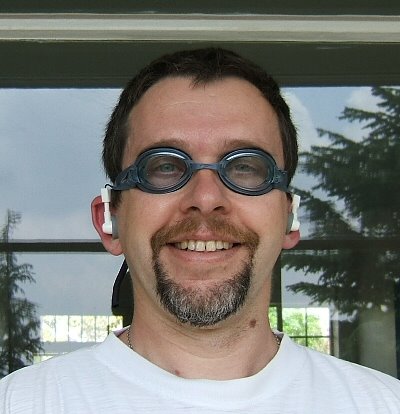
The combo consists of the OtterBox and an H2O Audio Headphone set. The photos above are yours truly trying everything on and trying to figure out how to get it all to fit.
Update: I have just returned from a most enjoyable swim. The OtterBox is not light: all the goodies including the iPod Shuffle weigh around 120g. By comparison, the plain Shuffle and (dry) earphones weigh around 50g. So it's more than double the weight. You don't notice it when you're in the water, because the Shuffle isn't around your neck. But I put the Shuffle in the OtterBox before leaving for the gym, to make sure the Shuffle was completely dry. Still, it's not that heavy, just different.
It takes a while to figure out how to get the earplugs to stay in your ears. Putting an elastic swimming cap on over the headset seems to help a bit too. When you're in the water it feels a bit weird, like having a personal angel on your neck or shoulder talking to you in the water. I'm going to need to choose the books I listen to carefully; I lost count of the number of lengths I was swimming. On the other hand, the audio book was interesting enough that I felt I could just keep on swimming for ages because I wasn't getting bored.
The photos show the headset plugging in to the top of the OtterBox, but I think it probably works better at the bottom. I'll try it at the top on my next swim. I also haven't experimented with the supplied armband yet.

Update: It's best to plug in the headset when the plug is at the top, because putting it at the bottom makes the cable go too close to your neck. So use it as illustrated.
My current iPod is serial number 5C5176FJRS9, and I have bought a spare one, serial number 4H625F3WRSA as a replacement when the batteries or flash memory fails in the first one.